Cage & Mirror Publishing
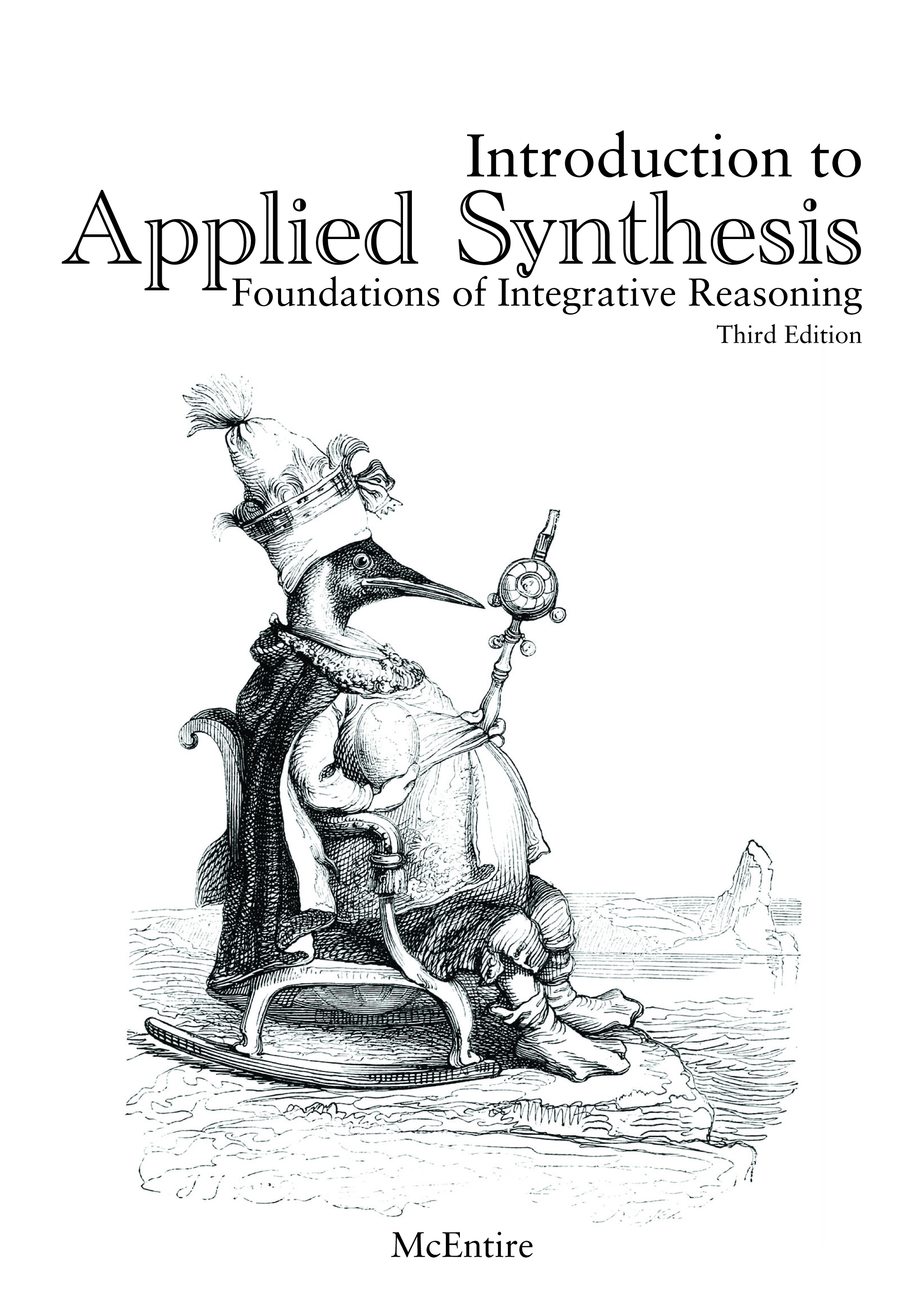
Introduction to Applied Synthesis
Foundations of Integrative Reasoning
Course Text, Third Edition
When information is free, what becomes scarce?
Book Details
- Publisher
- Cage & Mirror Publishing
- Status
- Available Now
- Pages
- 208
- Edition
- Third Edition
AI tools can answer any factual question in seconds. The bottleneck is no longer retrieval — it's the capacity to recognize what information means. To see patterns across domains. To notice when a model diverges from reality. To catch the moment your own reasoning has been compromised.
Introduction to Applied Synthesis is a rigorous course in the art of seeing what you've trained yourself not to see.
What This Book Is
This is not a collection of frameworks. It is not a self-help guide. It is a course — structured, demanding, and deliberately uncomfortable — that teaches the recognition and remediation of motivated perception: the systematic ways human reasoning becomes captured by forces we don't perceive, causing us to miss critical insights until hindsight makes the errors obvious.
The course presents fourteen domains where perception systematically fails. Each is introduced as a pattern, illustrated across multiple fields, and posed as a problem without a clean solution. The work progresses from conceptual frameworks to genuine insight, culminating in the ability to feel system alignment — not just analyze it.
The Fourteen Chapters
- The Wrong Variable — You see what's optimized. You miss what should be.
- The Symptom and the System — You see where the problem appears. You miss where it originates.
- The Stated and the Revealed — You see what people claim to value. You miss what their behavior shows they value.
- The Counterfactual — You see winners. You miss whether losers did the same things.
- First Principles — You see chains of reasoning. You miss assumptions that make the reasoning fail.
- Following Through — You see the first-order effect. You miss where the logic actually leads.
- Expertise and Credential — You see the qualification. You miss the capacity.
- Frameworks and Mechanisms — You see the vocabulary. You miss the understanding.
- The Tested — You see the new. You miss what time has proven.
- Redefining the Problem — You see the problem as stated. You miss that the frame itself is constraining.
- Structure Over Policy — You see rules requiring compliance. You miss structures that make compliance unnecessary.
- Process Over Metric — You see the number. You miss the dynamic it was supposed to measure.
- The Small Stressor — You see the crisis prevented. You miss the fragility created.
- The Current — You see friction as failure. You miss friction as signal.
Who This Book Is For
Leaders making decisions under uncertainty. Engineers designing systems. Consultants diagnosing organizations. Educators rethinking pedagogy. Anyone who suspects their reasoning has been shaped by forces they can't see — and wants to do something about it.
Prerequisites:
You should have already experienced significant failure in something that mattered. You cannot require external validation to feel competent. Academic success is actually a risk — confidence that effort guarantees results will block perception.
From the Book
"Before the prevalence of AI, finding information was the hard part. With easily retrievable information, any question can now be answered in seconds. This changes what education is for."
"In 1967, Robert McNamara faced an unfamiliar kind of war. The solution was body count. The gap between measurements and reality had grown wide enough to determine the course of a war."
"Enron Corporation displayed four corporate values prominently in its Houston headquarters: Respect, Integrity, Communication, and Excellence. The values displayed on the lobby wall bore no detectable relationship to the behavior that occurred in the building."
"This is motivated perception. Not ignorance — the information existed. Not stupidity — the reasoning capacity was present. Something in the structure of belief made the relevant inference unavailable."
"Credentials are granted by institutions based on legible criteria. Capacity is developed through practice and earned from reality."
Sample Chapter: The Counterfactual
You see winners. You miss whether losers did the same things.
During World War II, the U.S. military analyzed bombers returning from missions over Europe. Engineers mapped the bullet holes across the aircraft — wings, fuselage, tail — and recommended reinforcing the areas with the most damage.
A statistician named Abraham Wald saw what the engineers missed. The aircraft being studied were the ones that had returned. The bullet holes showed where a plane could be hit and survive. The areas with no damage — the engines, the cockpit — were the areas where hits were fatal. The planes hit there never came back to be studied.
This is survivorship bias in its purest form. The data is real. The analysis is competent. The conclusion is exactly backward — because the sample is filtered by the outcome you're trying to understand.
The pattern is everywhere. You study successful companies and extract their common traits without knowing whether failed companies had the same traits. You read a biography of a successful founder and absorb the narrative of persistence, risk-taking, and vision without asking how many founders with identical traits failed. You evaluate a strategy based on the companies that adopted it and succeeded without examining the companies that adopted it and collapsed.
Success creates a platform. Failure is invisible. You cannot evaluate advice without knowing what happened to others who followed it.
Consider a mutual fund advertisement: "Our fund has outperformed the S&P 500 for 15 consecutive years." This sounds impressive. But you are looking at the fund that survived. The fund company may have launched 40 funds 15 years ago. The ones that underperformed were quietly merged or closed. The one that outperformed — by luck, by market conditions, by the statistical certainty that someone in a large enough group will flip heads 15 times — gets advertised.
Clean narratives about success indicate that failures have been filtered out. The cleaner the narrative, the stronger the filter.
What Makes This Different
- Not frameworks — perception. Frameworks organize information. This course develops the capacity to see what frameworks miss.
- Not answers — discomfort. Many of these problems don't have solutions. They have tradeoffs. The course teaches you to sit with that.
- Not theory — application. Case studies span military strategy, healthcare, technology, city planning, organizational design, and personal decision-making. The patterns are universal.
- Not grades — evidence. Assessment is by portfolio. Grades reflect evidence of perceptual change, not thoroughness, completeness, or effort.
The Integrated Student
Throughout the book, a student named Olivia Chen works through all fourteen chapters. Her journey models the transformation the course aims for — from framework fluency and performative competence to genuine perceptual shift. Her margin notes, evolving self-awareness, and struggle with C grades despite strong effort show what real learning looks like: messy, uncomfortable, and irreversible.
"You've stopped performing and started looking. Whether you keep looking is not something I can assess until you do it."