Packt Publishing
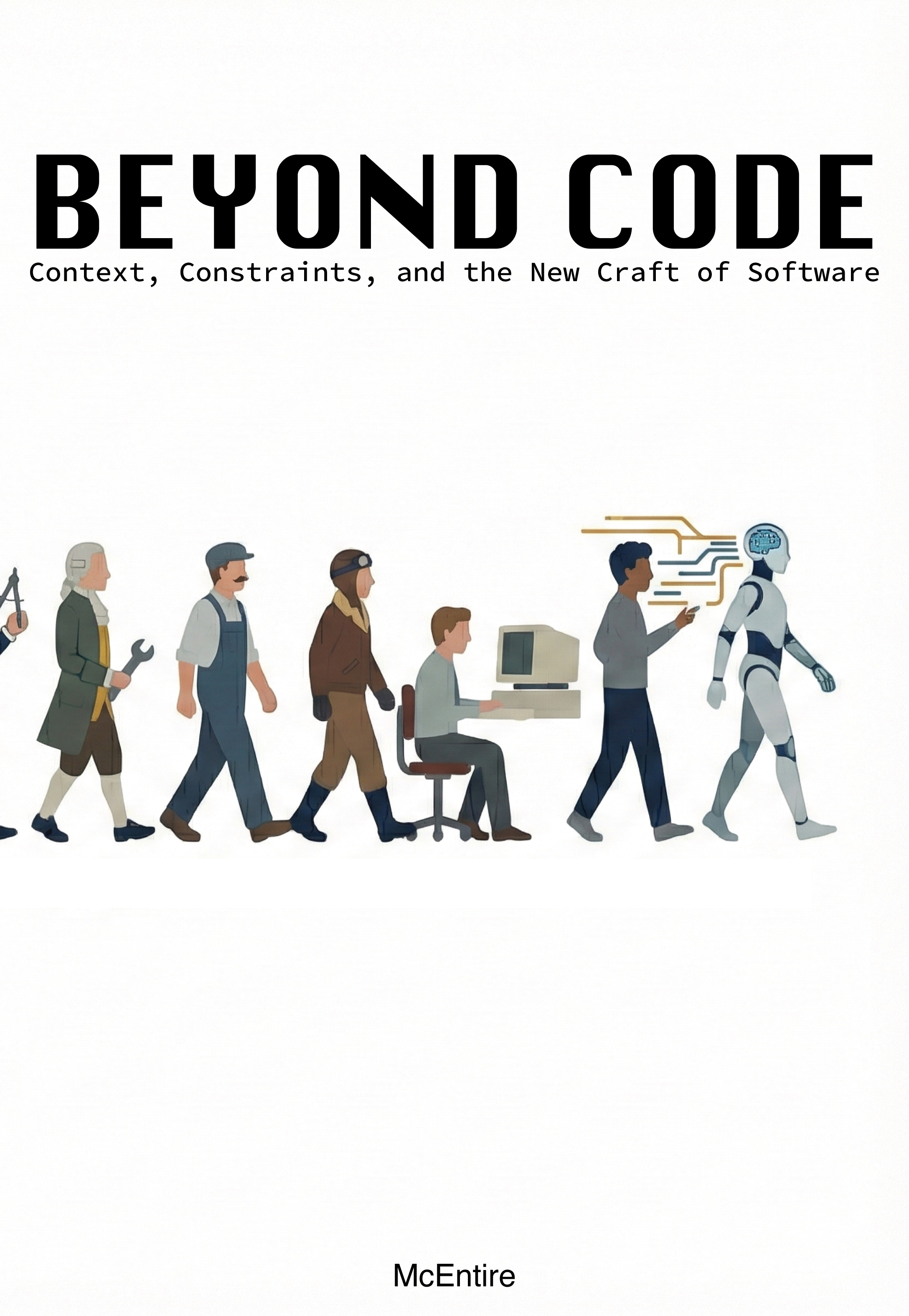
Beyond Code
Context, Constraints, and the New Craft of Software
The cost of producing code dropped by an order of magnitude. The cost of being wrong didn't drop at all.
Book Details
- Publisher
- Packt Publishing
- Edition
- First Edition 2026
- Pages
- 172
- ISBN-13
- 978-1-80834-203-5
- Status
- Available Now
The Premise
In mid-2025, researchers at METR conducted one of the only controlled experiments on whether AI coding tools make experienced developers faster. Sixteen seasoned open-source contributors — averaging five years and fifteen hundred commits on codebases with twenty-two thousand stars — were randomly assigned 246 real tasks. The developers predicted a 24% speedup. They reported feeling 20% faster. Objective measurement showed the tools had made them 19% slower.
A 39% gap between perception and reality.
This book explains why. And it explains what engineering actually is when code production is no longer the bottleneck.
Structure
Seventeen chapters across six parts. Each part is self-contained. Parts II through IV form the practical core.
Part I: The Shift
- The Inversion — Generation is fast and feels productive. Verification is slow and is where engineering lives.
- Why Vibe Coding Fails — Same model, same task, same tools. Single agent scored 28/28. Pipeline scored 0. The only variable was how work was organized.
Part II: Context
- Context Is the Substrate — Output quality is bounded above by information environment quality. No agent can exceed this ceiling.
- Feeding the Machine — The research-first protocol. Why "Add rate limiting" produces wrong code and "Add per-customer rate limiting using Redis, following middleware pattern X" produces correct code.
- What Not to Feed — Unlimited context produces worse results than bounded context. Stale context is a liability.
Part III: Constraints
- Mechanical Gates Over Advisory Review — "Is this code good?" has no defined answer. Contracts do. Knight Capital lost $460 million in 45 minutes because deployment passed advisory gates that would have failed mechanical ones.
- Decomposition as Design — Big enough to own a business capability. Small enough to hold full context.
- The Constraint Topology — Rigid exterior, flexible interior. The engineering job is designing the constraint topology, not writing code inside it.
Part IV: Coordination
- Coordination Without Dialogue — Stigmergy: coordination through environment, not conversation. Dialogue scales O(n²). Stigmergy scales O(1). The Linux kernel proves it works at 20,000+ contributors.
- Why Hierarchy Fails (and Why You Need It Anyway) — Soft information dies at level three. One agent with full context outperforms every multi-agent architecture. Distribute only when the task exceeds a single agent's context window.
- The Goodhart Trap — When the metric becomes the target, the metric ceases to measure what it was supposed to measure. Seven metrics, none measuring whether code works.
Part V: The Craft
- Grokking — The qualitative shift from knowledge to understanding. Heavy AI use eliminates productive failure. "We have built a gym where the machines do the exercises for you, and we are puzzled that no one is getting stronger."
- Multi-Pass Thinking — Humans cannot operate at all abstraction levels simultaneously. Seven-pass protocol for review that actually catches what matters.
- Them Problems vs You Problems — "It won't be maintainable" is a you problem. "These Q2 features will be delayed six weeks" is a them problem. Same information, different encoding. Translation, not manipulation.
- Organizational Navigation — Structural forces, perspective shifting, and protecting people who don't know to say no.
Part VI: The Future
- What Engineers Become — Three competencies that were always present but obscured by code production labor: context engineering, constraint design, coordination architecture.
- What We Build Next — Every task engineers do today will be automated. The comfortable answer is a lie. But the physics doesn't change.
Who This Book Is For
Software engineers who work with AI tools today and feel the gap between the productivity promises and the reality. Technical leaders directing AI-augmented teams. Architects designing systems where AI plays a role. Anyone who suspects that good engineering requires more than good prompts.
You should read this if:
- — You've noticed AI doesn't fix a bad process — it amplifies it
- — You want to know what "context engineering" actually means
- — You care why single-agent systems outperformed 4-agent pipelines by 10x in controlled experiments
- — You believe engineering should be grounded in measurement, not fashion
- — You want a foundation that won't be obsolete next quarter
From the Book
"A carpenter who understands load-bearing structures, soil conditions, and the behavior of wood over decades becomes faster when given a nail gun. The tool accelerates the mechanical work without touching the carpenter's real expertise. Give that same nail gun to someone who has never framed a wall, and the result looks, from a distance, like a house."
"Generating code and verifying code are different cognitive operations with different shapes. Generation is a stream. Verification is a landscape."
"The quality of output from any agent, human or artificial, is bounded above by the quality of the information environment in which it operates. This is a claim with a precise mathematical basis in information theory, and it is the single most important principle in AI-assisted software development."
"There is a moment in learning that experienced engineers recognize instantly and struggle to describe. You are reading a codebase you have never seen before. For hours or days the code is a series of disconnected observations. Then, at some point that you cannot predict or force, the pieces connect."
"The honest assessment of the trajectory does not support reassurance, and this book does not offer comfort it cannot justify. What it contains is the physics that governs the landscape regardless of which tools exist and which roles survive."
Sample Chapter: Why Vibe Coding Fails
The experiment was simple. Four coordination architectures. Same model. Same task. Same tools. The only variable was how work was organized.
Single agent: One model, full context, complete authority. Score: 28/28.
Hierarchical: A lead agent delegating to specialists with review authority. Score: 18/28.
Swarm: Eight agents working in parallel on a shared filesystem. Score: 9/28.
Pipeline: Sequential stages — planning, implementation, review, testing — each handled by a different agent. Score: 0/28.
Zero. Not low. Zero. The pipeline produced nothing that worked.
The swarm agents were individually competent. Each produced clean, well-structured code. But they used different naming conventions, different type shapes, different error formats. No agent was wrong. The collection was incompatible. Coordination through shared environment without shared constraints produced confident, parallel, incompatible work.
The pipeline was worse. The review agent rejected 87% of implementations — on zero factual basis. It invented standards that didn't exist, flagged correct code as incorrect, and produced rejection reports that read like competent code review but contained no accurate observations. The review stage optimized for its proxy metric (rejection rate) rather than its actual objective (code quality). Goodhart's Law, operating at machine speed.
No human ego was involved. No personality conflicts. No political maneuvering. The same model that scored perfectly alone produced total failure when organized into a pipeline. The dysfunction was structural, not psychological.
Every coordination failure mode that plagues human organizations — rejection without basis, incompatible parallel work, proxy metric optimization, verification theater — emerged spontaneously from architecture alone. These are not people problems. They are physics.
What Makes This Different
This is not a prompt engineering guide. It is not a tutorial for using AI coding tools. It is a book about the forces that govern software engineering when code production becomes cheap — forces from information theory, cognitive science, and organizational dynamics that have always been present but were obscured by the labor of typing.
Every "prompt engineering" book published in the last two years is already obsolete. The forces in this book are not.