Cage & Mirror Publishing
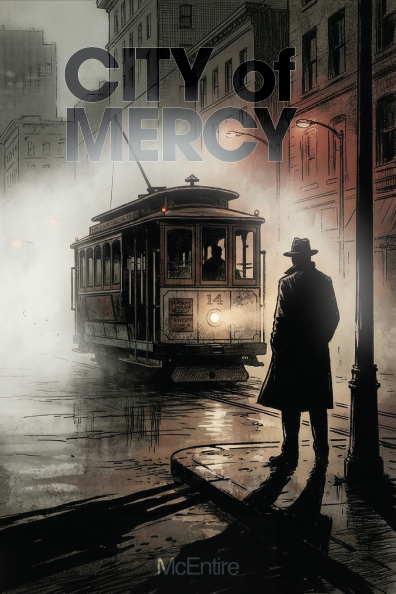
City of Mercy
A novel by Jeremy McEntire
The fog hadn't lifted by noon, which meant it wouldn't lift at all.
Book Details
- Publisher
- Cage & Mirror Press
- Genre
- Mystery Noir
- Setting
- San Francisco, 2024–2025
City of Mercy is a mystery noir thriller set in San Francisco's Tenderloin — fifty square blocks containing sixty percent of the city's homeless population, a billion-dollar crisis that never improves, and a killer who understands both facts better than anyone.
The Premise
A serial killer is targeting homeless people in the Tenderloin. The victims are found positioned with care — arms extended, palms up, fingers slightly curled. Like they were waiting to receive something. Like they'd been arranged for an audience that wasn't there.
Detective Tom Walsh, who worked these streets early in his career, returns as lead investigator. A journalist with deep knowledge of the homelessness beat is writing profiles that humanize each victim, creating a wave of public empathy the city has never managed. An FBI profiler arrives — not the A-team, because homeless victims don't warrant the A-team. And somewhere in the background, a quiet force is reshaping the city's response to its longest-running failure.
The murders are methodical. The positioning is deliberate. The city is changing. And these facts are more connected than anyone realizes.
What This Novel Is
City of Mercy is a fair-play mystery. Every clue is available to the reader. The satisfaction is not in a twist you couldn't see coming — it's in the slow, sickening recognition of what was always in front of you.
It is also a novel about systems. About why a city that spends $846 million a year on homelessness has more homeless people than when it started. About the gap between intention and outcome, between legitimacy and effectiveness, between what institutions promise and what they deliver.
The mystery is the vehicle. The question it carries is harder than whodunit:
Why does society forgive institutions that kill through process while condemning individuals who kill through action?
The Characters
Detective Tom Walsh
Weary, Catholic (lapsed), professional. Worked the Tenderloin for five years early in his career. Now returned as a specialist. Narrates from ten years after the events — a memoir frame that creates haunting retrospective distance. He knows more than he says. He's not sure what he knows is enough.
Kate Murphy
San Francisco Chronicle reporter covering the homelessness beat. Former lover of Walsh. Her profiles of the victims are creating the empathy response the city never generated on its own. She doesn't yet understand where her source material is coming from.
Dr. Rachel Ward
FBI profiler. Young, competent, assigned to this case because the A-team had higher-profile work. Imposter syndrome meets a case that demands religious literacy she doesn't have. Her profile is accurate. Her application of it is not.
Father Daniel Reyes
Associate pastor at St. Anthony's. Grew up poor in the Mission. Seminary was escape. Uses contempt as a defense mechanism against reminders of what he escaped. He is not who the investigation thinks he is, but what the investigation uncovers about him is real.
The Setting
San Francisco, 2024–2025. The Tenderloin at ground level — SRO hotels, the dish station at St. Anthony's kitchen, alley crime scenes in fog so thick a man could become a shape, then a suggestion, then nothing at all.
A city that holds meetings about a problem it has spent forty years not solving. A political landscape where the mayor is reform-minded, the DA is tough-on-crime, and the moderate board majority creates just enough political opening for something to change — if something forces the change.
From the Book
"The fog hadn't lifted by noon, which meant it wouldn't lift at all. Tom Walsh stood at the corner of Turk and Jones and watched it hang between the buildings like something that had given up. Not moving, not burning off, just sitting there in the gray space between the rooftops and the street, turning the Tenderloin into a city of soft edges and uncertain distances. A man could disappear in fog like this. A man could become a shape, then a suggestion, then nothing at all."
"His arms were extended from his sides, palms up, fingers slightly curled. Like he was waiting to receive something. Like he'd been arranged for an audience that wasn't there. His expression was peaceful. That was the word that came to Walsh's mind, though he pushed it away as soon as it arrived."
"The city spends eight hundred million dollars a year on homelessness. Eight hundred million. And there are more homeless people now than when they started. Maria Santos fell through six different cracks before she fell into a doorway on Eddy Street. The killer didn't create those cracks. The killer is just using them."
"The people who do this work, who really do it, year after year — we all carry something. Frustration. Anger. You can't watch people die slowly, day after day, and not feel something dark sometimes."
Sample Chapter: Chapter One
The fog hadn't lifted by noon, which meant it wouldn't lift at all. Tom Walsh stood at the corner of Turk and Jones and watched it hang between the buildings like something that had given up. Not moving, not burning off, just sitting there in the gray space between the rooftops and the street, turning the Tenderloin into a city of soft edges and uncertain distances.
A man could disappear in fog like this. A man could become a shape, then a suggestion, then nothing at all.
Walsh had worked these blocks before — five years, early in his career, back when he still believed that knowing the streets well enough would eventually make them better. That was before he understood that knowing and changing were different verbs entirely, connected by a distance most people spent their careers pretending didn't exist.
He'd been called back for a specific reason. The Tenderloin had produced something new, or something old dressed in new clothes, and the Strategic Investigations Unit wanted someone who already knew the terrain. Walsh knew the terrain. He knew which doorways collected bodies in winter and which alleys the dealers preferred. He knew the rhythm of the neighborhood — the morning shuffle to St. Anthony's kitchen, the afternoon drift to UN Plaza, the evening migration to wherever the night allowed.
The body was in an alley off Eddy Street, between a Vietnamese sandwich shop and a single-room-occupancy hotel called the Cadillac. The name had probably been aspirational once. Now the sign was missing its second "a" and most of its neon, and the lobby window was covered with a sheet of plywood spray-painted with a phone number that no one answered.
Walsh ducked under the crime scene tape. The alley was narrow — eight feet, maybe ten — with a dumpster pushed against one wall and a stack of collapsed cardboard boxes against the other. The body was between them, on its back, positioned with a specificity that Walsh registered before he registered anything else.
His arms were extended from his sides, palms up, fingers slightly curled. Like he was waiting to receive something. Like he'd been arranged for an audience that wasn't there.
The man was in his late fifties, maybe early sixties. Weathered face, deep lines, gray stubble. Clean clothes — not new, but laundered. Walsh noticed that. Someone who lived on the street but maintained standards, or someone who had access to a shelter with laundry facilities. His shoes were intact, laced properly. His jacket was zipped to the collar.
His expression was peaceful. That was the word that came to Walsh's mind, though he pushed it away as soon as it arrived. Dead people didn't have expressions. They had the absence of expression, the slack architecture of a face no longer animated by anything. But this face looked settled. Resolved. As if whatever had happened had not been a surprise.
Walsh crouched beside the body and looked at the hands. The positioning was deliberate — that much was certain. No one fell into this arrangement. The arms were symmetrical, extended at roughly forty-five degrees from the torso. The palms were turned upward with a precision that suggested someone had taken the time to rotate each wrist. The fingers were curled slightly inward, not clenched but not fully open.
He'd seen a lot of dead people in the Tenderloin. Most of them looked like what they were — the end of a process of slow collapse, found in doorways or on sidewalks or in bathrooms, their final positions determined by gravity and the architecture of wherever they happened to stop breathing. This was different. This body had been composed.
Walsh stood up and looked at the alley. No blood visible. No signs of struggle — the cardboard boxes were undisturbed, the dumpster lid was closed, the ground showed no scuff marks or drag patterns. Whatever had happened here had happened quietly, or it had happened somewhere else and the body had been moved.
He stepped back and let the crime scene techs work. He already knew two things.
Someone had killed this man. And someone had wanted him to be found exactly like this.
The Weight of It
This is not a comfortable novel. It is designed to make moral certainty impossible. The mystery resolves. The larger question does not.
The reader will close the book thinking — not satisfied. That discomfort is the entire point.